Did you find yourself doomscrolling through Cyclone Alfred? Here’s why
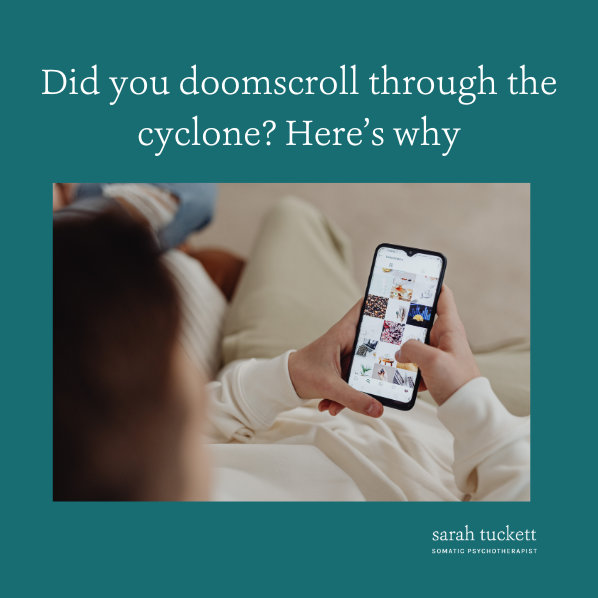
“I was doomscrolling for hours on end and didn’t achieve anything”
“I couldn’t focus on my work/studies. Nothing would go in”
“I stayed in bed and slept for hours”
This week post-Alfred, clients have been berating themselves for not being able to work or read or do anything ‘useful’ in those long days leading up to Cyclone Alfred.
So I want to let you know that how they felt is completely NORMAL. And that I too was in a similar state.
On Thursday and Friday I had cancelled all my clients because we had thought the cyclone was hitting, and because I too was in a heightened state and didn’t think I had the capacity to be a good therapist.
I had two entire free days to read, to write, catchup on research. And yet I didn’t do anything. I wasn’t capable of doing anything. I just lay on my bed, doomscrolling on Insta for hours at a time.
I was in a nervous system state of ‘shutdown’. And I bet some of you were too.
Doomscrolling and Mental Health
Doomscrolling has negative outcomes for mental health. I don’t need to tell you this. You’re an intelligent person and so am I (allegedly). So why did I do it?
Because I was going into Dorsal (shutdown) nervous system state. And my awesome nervous system was simultaneously looking for updates on Alfred and how to be prepared, and also looking for distraction. Doomscrolling was my brain’s solution.
Why you weren’t able to do anything productive
When your nervous system calculates that a stressor is too big to fight or we are unable to flee, it has three other options: freeze, collapse and fawn. These are ancient nervous system strategies to protect you and keep you safe in an event of high stress.
Your nervous system was trying to protect you from the enormous stressor of Cyclone Alfred. It was doing it’s best to keep you alive.
These nervous system strategies are unconscious. i.e. they are below the level of your conscious control.
Rather than thinking of these nervous system strategies as binary (i.e. just fight, or just collapse), know that there are gradations between them, and they can exist at the same time.
The famous polyvagal researcher Deb Dana has illustrated the nervous system as a step ladder. You can go up and down a ladder, just as you are meant to go up and down the various states of your nervous system, depending on what’s going on around you.
Here’s my recreation of her famous Autonomic Nervous System Ladder image:

Note that there are more than 3 steps on this ladder. It’s not just 3 nervous system states. There’s all the steps in between. You can be a little bit jittery or a hot mess and every step in between.
Ventral Vagal – top of the ladder and feeling gooooood!
In this state ALL the parts of your nervous system are working together. You can think, focus on your work, communicate, and you have full access to your executive functioning (planning, creativity, brainstorming).
You can also move, play, do sports.
You can also rest and digest.

Sympathetic State – action, fight or flight
Not necessarily a state of fight/anger. It could be as simple as needing to take quick action: “Yikes I’m going to miss the bus if I don’t peg it down the road! Ruuuuun Forest, run!”
This is your body preparing you for action, whether out of excitement or fear.
You know the saying “There’s a fine line between excitement and fear”? Here’s why:
You can be amped in excitement, dancing around your living room (where you have both Ventral Vagal system and Sympathetic systems working together).
Or you can be jittery and shakey with fear, wanting to leg it out of there (Just Sympathetic – we’ve lost Ventral).

Note that:
- Your digestion is switched off – it’s not an essential service that is needed whilst you are in the middle of a fight.
- Part of your pre-frontal cortex is also ‘shut down’. You don’t need to be rationalising and thinking creatively if there’s a bear at your front door – you need to get the hell out of there. (Blummin drop bears!) This is why it’s hard to study/work/read when you’re in that state. Part of your mammalian brain has ‘checked out’.
Dorsal Vagal State – shut down
This is the place I went to with my Instagram doomscrolling. Shutdown. Very little movement. Reduced breathing. Social withdrawal.
In this dorsal vagal state our movement and respiration are reduced. It’s designed to protect us when the threat is so overwhelming that we can’t flee or fight. (Or aren’t able to flee because there’s a life-threatening storm looming for blummin days because he really took his sweet time).
Our pre-frontal cortex is shut down, so it might be difficult to communicate what you’re feeling. Social withdrawal might feel preferable. “Oh look there’s my phone… I can numb out”.

How do I get back up the ladder?
Movement
(If I could make that text Fluro and animated like a bad 90s PowerPoint I would).
It’s that simple.
We have to MOVE to get back up the autonomic ladder.
On Thursday I went between vigorously chopping back the giant bamboo beside my studio (more of a ‘fight’ mobilised state). Other times I went for little walks around my suburb.
I felt SO much better because I was moving and in doing so, getting back up the autonomic ladder.
Even if you can’t get outside during a time of huge stress, move your body.
- Do a few squats
- Shake your limbs
- Put on your favorite music and dance
And definitely stick your middle finger up to the Cyclone.
If you do go into ‘shutdown’, please be kind to yourself. This is your nervous system trying to protect you the best way it knows how. Be gentle with yourself.
I hope this helps you understand why you were doomscrolling (or similar).